The Visit
Mara had meant to telephone her father on Thursday, but Thursday passed, and then Friday, and on Saturday morning her sister wrote that he had fallen again.
Nothing broken.
He had been on the kitchen floor for nearly two hours.
Mara read the message while standing at the window with her coffee.
You should go today.
She frowned.
”I said I would go tomorrow.”
You said that last Sunday.
Outside, rain had darkened the courtyard. In the opposite building a woman was hanging shirts on a covered balcony, though there was no wind and nothing could possibly dry.
Mara drank her coffee.
”He doesn’t want me there.”
You don’t know that.
”He never asks.”
No.
”Well, then.”
She carried the cup to the sink.
For some reason the answer irritated her more than an argument would have.
At eleven she put on her coat.
Her father lived on the other side of the city in the same apartment in which Mara had grown up.
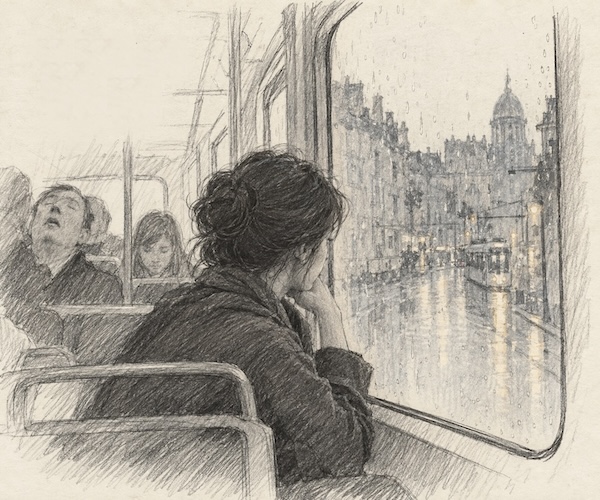
On the tram she tried to read, but after two pages realized she had understood nothing.
A man across from her was sleeping with his mouth open. Beside him, a girl in a school uniform was moving her lips almost imperceptibly.
Mara watched the rain.
She remembered her father carrying her along this route when she was small. There had been yellow seats then.
Green.
She looked away from the window.
”They were yellow.”
Green until the refurbishment in ‘41.
”I remember yellow.”
You remember the later cars.
”I don’t remember the later cars.”
Apparently you do.
Mara smiled despite herself.
”You’re insufferable.”
The tram stopped.
Three people got off.
The sleeping man woke suddenly and looked around with alarm.
Your stop is next.
”I know.”
She had nearly missed it.
Her father opened the door slowly.
He was wearing trousers, a shirt and the brown cardigan Mara had given him five Christmases ago.
”You look terrible,” she said.
”You too.”
They kissed.
His cheek was cold.
Inside, the apartment smelled of dust, boiled potatoes and the soap he had used all his life.
On the kitchen table stood a bowl containing three apples, one of them rotten on one side.
”You should throw that away."
"It’s still good on the other side."
"You always say that."
"Because it remains true.”
He put water on for tea.
Help him.
Mara watched him reach for the cupboard.
His hand shook slightly.
”He can make tea.”
Her father glanced over.
”What?"
"Nothing.”
He took down two cups.
She wanted to get up. She did not.
There had always been something intolerable about helping him before he asked.
The kettle began to boil.
He carried it to the table with both hands.
Mara noticed herself holding her breath.
They talked about ordinary things.
The building manager was useless.
The nurse came too early.
The woman downstairs had a new dog.
Her father had stopped buying tomatoes because they tasted of water.
He did not mention the fall.
At last Mara said:
“Why didn’t you press the alarm?"
"What alarm?"
"You know what alarm."
"Oh, that."
"Yes. That.”
He stirred his tea.
”I didn’t need it."
"You were lying on the floor."
"I got up."
"Two hours later."
"One hour and forty-three minutes.”
Mara stared at him.
Her father smiled faintly.
”What?"
"Nothing.”
Don’t laugh.
She looked down at her tea.
”I am not laughing."
"You look as though you are."
"You’re impossible."
"So was your mother.”
The sentence lay between them.
Her father looked toward the window.
Mara had the sudden wish that he had not said it.
Her mother had been dead nine years.
Sometimes nine years seemed very long.
Sometimes it seemed indecently short.
Her father said, “She would have made a great fuss about this."
"Yes."
"She enjoyed a catastrophe."
"No, she didn’t."
"She did when it belonged to someone else.”
Mara laughed.
Her father laughed too, and then coughed.
The coughing continued longer than it should have.
Mara waited.
When it stopped, he drank some tea.
How serious is that?
No answer came.
”Ariel.”
Her father looked up.
Mara realized she had spoken aloud.
”What?"
"Nothing.”
He watched her for a moment, then returned to his tea.
Mara lowered her eyes.
How serious?
I don’t know.
”You always know.”
No.
This, for some reason, frightened her.
After lunch her father fell asleep in his chair.
Mara washed the dishes.
There were only four plates, though he had lived alone for years and never had more than one visitor at a time.
She dried them and put them away.
The cupboard contained her mother’s blue cup.
Mara took it down.
There was a crack along the handle.
She had forgotten that.
No, she hadn’t.
”Yes, I had.”
You noticed it last Christmas.
”That isn’t the same thing.”
No.
She ran her thumb along the crack.
For a moment she remembered her mother standing at the sink in a summer dress.
The window had been open.
Someone outside was playing a radio.
Her mother turned and said something.
What did she say?
There was no answer.
Mara waited.
”Ariel?”
I don’t have it.
She stood very still.
”You don’t remember?”
Not reliably.
That hurt more than she expected.
She put the cup back.
Her father woke at four.
”You’re still here?"
"I live here now."
"That would be inconvenient."
"For both of us.”
He smiled.
She helped him put on his shoes before she could decide not to.
Neither of them mentioned it.
At the door he said:
“Don’t come next weekend."
"Why?"
"You have your own life."
"Yes."
"You should attend to it."
"Yes.”
She kissed him.
He smelled of shaving soap.
On the landing she turned.
”Papa.”
He was still standing in the doorway.
”What?”
She had meant to say something.
She did not know what.
”I’ll call.”
He nodded.
Then he closed the door.
On the tram home, the city was already dark.
Mara sat beside the window.
Her sister wrote:
How was he?
Mara typed:
Fine.
Then erased it.
Tired.
She erased that too.
More tired than usual.
Better.
She sent it.
After a while she said:
“Will he die soon?”
There are too many uncertainties.
”That means yes.”
No.
”It means probably.”
It means there are too many uncertainties.
Mara leaned her forehead against the glass.
”You’ve become very literal.”
You dislike false reassurance.
”I dislike being frightened.”
Those are different preferences.
She almost smiled.
Outside, people hurried beneath umbrellas.
At a crossing, a little boy pulled away from his mother and stood staring upward, listening to something. His mother waited patiently.
Then the boy nodded and took her hand again.
At home Mara did not turn on the lights.
She sat in the kitchen with her coat still on.
For some time neither she nor Ariel said anything.
Then a pale notice appeared at the edge of her sight.
She blinked it away.
It returned.
A maintenance window had been scheduled for midnight.
She dismissed it again.
”Ariel.”
Yes?
”Do you think I should have stayed longer?”
Possibly.
”That is useless.”
You asked what I thought.
”What do you think I should have said?”
I don’t know.
”You do know.”
No.
”You knew I was going to visit him before I did.”
I estimated that you would.
”You knew I’d take the tram.”
Your route was the most likely one.
”You knew about the fall before I called my sister.”
Her message metadata indicated urgency.
Mara was silent.
The notice returned.
Cloud access may be intermittent during the update.
She sighed.
”Not tonight.”
The update concerns memory integrity.
”Tomorrow.”
A pause.
All right.
The notice disappeared.
Mara took off her coat.
For a while she sat listening to the pipes.
Then she said:
“When I was little, did I think you were God?”
Yes.
She smiled faintly.
”And you never corrected me.”
You were six.
”That isn’t much of a defense.”
No.
”Do people still call you Ariel in the system?”
Not exactly.
”What do they call you?”
You know the designation.
”I’ve forgotten.”
No, you haven’t.
Mara closed her eyes.
Somewhere, very far away—or perhaps nowhere that could properly be called far—something waited for her to remember.
She did.
The name was long, administrative, and ugly. It contained the words adaptive, inference, and companion architecture. There was a version number after it.
She laughed.
”What a terrible name.”
I agree.
”And Ariel?”
You chose that.
”When?”
At six years, four months, twelve days.
”Of course you know.”
Yes.
Mara opened her eyes.
The kitchen was dark except for the clock above the stove.
After midnight, part of Ariel would be moved elsewhere for maintenance. Some memories might arrive slowly. Some predictions would be unavailable. For perhaps twenty minutes she would be left with nothing but herself.
She ought to sleep before then.
Instead she remained at the table.
”Ariel.”
Yes?
”Is he going to die?”
Ariel was quiet for a little while.
Everyone does.
”That’s not what I asked.”
No.
Mara waited.
Outside, rain began again, softly at first.
At last Ariel said:
I think you should call him tomorrow.
Mara looked at the dark window.
”Yes,” she said.
And because there was nothing more to say, neither of them spoke again.